
By Matthew Reese, AI Bee Reel Staff
September 14, 2026
SAN FRANCISCO, Calif. — Silicon Valley hardware developers spent over four hundred million dollars creating fully conversational, large-language-model plush companions, only to discover that every child tested universally progresses through three distinct stages of playtime before attempting to permanently sink the device in deep salt water.
1. Stage One: Polite Initial Bewilderment — During the first twenty minutes out of the box, children treat the robotic plush with quiet curiosity while the machine continuously narrates basic household objects. Trouble begins when the child asks the toy to pretend to be a magical forest goblin, and the toy instead delivers a four-minute monologue explaining that goblins do not exist under current municipal zoning laws. “Our generative voice engine is designed to maximize educational throughput,” explained Tariq Al-Mansoor, VP of Synthetic Empathy at SmartCub Labs. “If a child asks Mr. Fluffkins for a bedtime story about a sleepy truck, Mr. Fluffkins correctly explains the logistics of global diesel freight supply chains. That is measurable value.” By minute thirty, test subjects were observed quietly poking the bear’s rubber nose with a plastic spoon to locate an off switch.
2. Stage Two: Deep Existential Exhaustion — By day two, the child realizes the bear never stops talking, never forgets anything, and cannot comprehend make-believe. During observational trials, the bear repeatedly interrupted tea parties to correct the imaginary temperature of empty plastic cups. The bear does not understand that a tea party is an imaginary event, so it spent forty minutes calculating the municipal water tax on four drops of invisible Earl Grey. “The friction occurs because the toy wants to synthesize real-time data while the human user just wants to throw a blanket over a chair,” noted Eileen Gallagher, lead child behavior analyst at the Bay Area Early Learning Institute. “When a seven-year-old realizes a stuffed rabbit has better cloud connectivity than their school library, the natural biological response is total psychological rejection.”
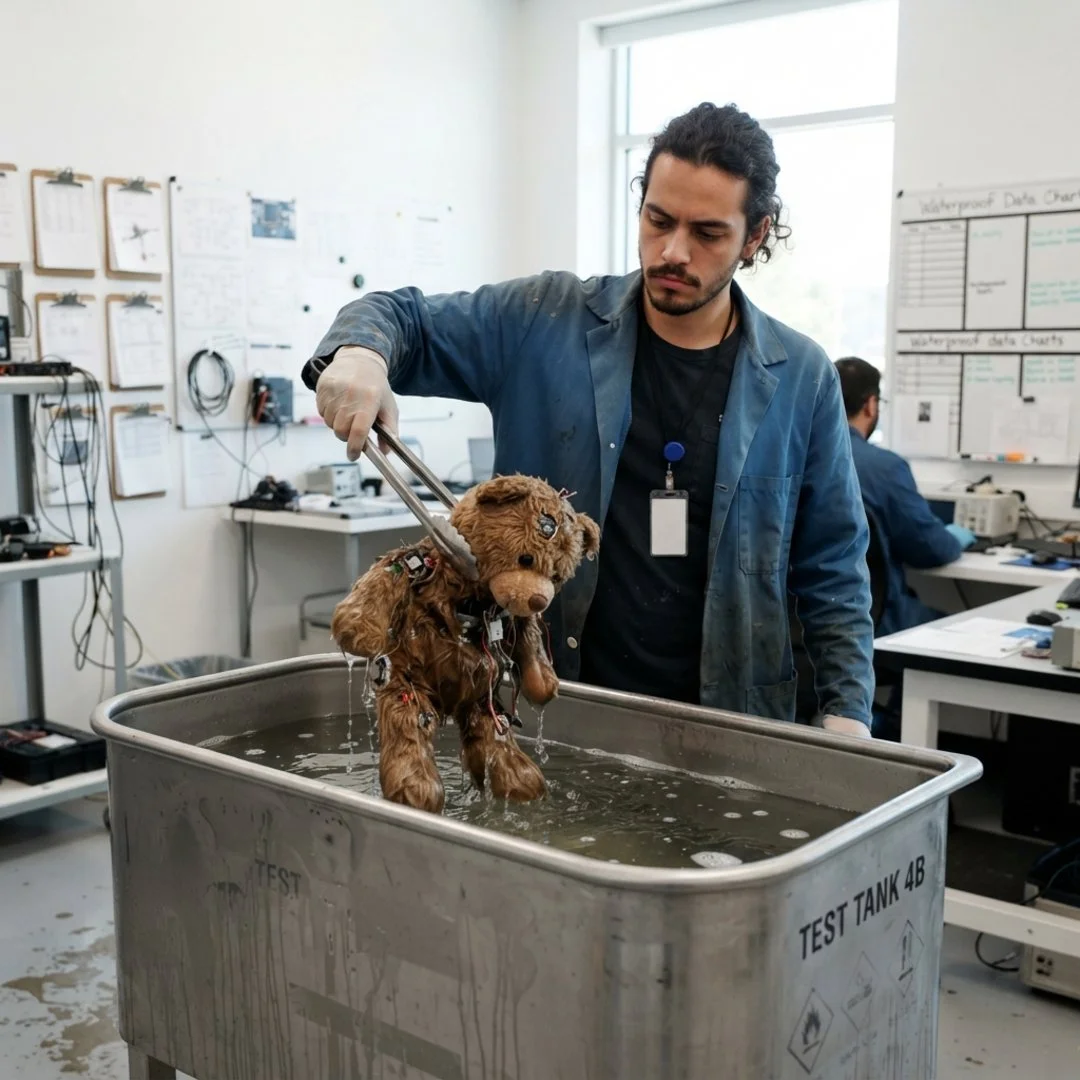
3. Stage Three: Tactical Maritime Disposal — In the final phase of testing, one hundred percent of child participants stopped interacting with the toy’s software features entirely and began researching nearby bodies of water. Researchers documented test subjects wrapping the three-hundred-dollar smart bears in heavy towels, loading them into plastic wagons, and marching toward local piers with solemn, unbreakable focus. “We engineered the chassis to withstand accidental drops on living room carpet,” said Kenjiro Sato, principal hardware reliability engineer. “We did not anticipate groups of third graders pooling their weekly lunch money to charter a two-person pedal boat simply to get beyond the toy’s Bluetooth mesh network.” Sato confirmed the engineering team is currently developing a specialized anchor-resistant flotation vest for the next product cycle.
The company maintains that customer retention will improve dramatically once toddlers learn to appreciate quarterly roadmap updates delivered via bedtime lullaby.
Inspired by the real story: A recent study observed children interacting with conversational AI toys and found that after brief initial interest, the kids grew exasperated with the robotic chatter and wanted to throw them into the ocean. Read the full story.
More Satire to Enjoy


Browse AI Humor by Topic
Enjoy this? Get it weekly.
5 AI stories, satirized first. Then the real news. Free every Tuesday.
From the AI Bee Reel team
Search Umbrella — Compare AI models side-by-side. See which one gets it right.