
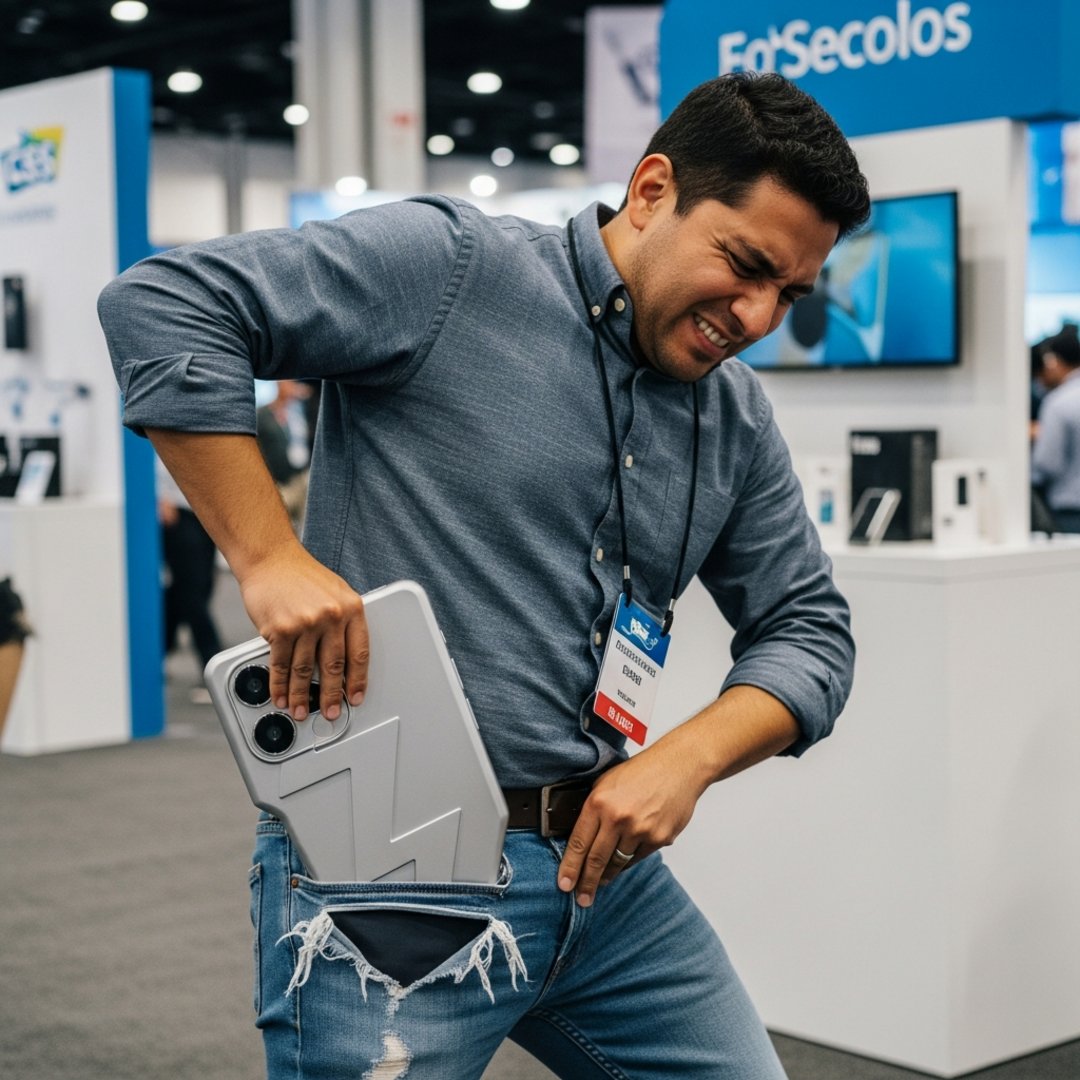
Industry leaders insist the shift away from ergonomics is a strategic necessity to keep users connected. “We realized that when a phone slides easily into a pocket, engagement drops to zero,” said Marcus Chen, Vice President of Hardware Design at SharpEdge. “By manufacturing a chassis with seven distinct jagged points, we ensure the user physically cannot put the device away without risking laceration. We call this ‘Pain-Led Retention,’ and early data shows it increases screen time by 400% simply because users are afraid to let go.”
The trend of hostile geometry dominated the show floor, overshadowing the traditional AI-powered washing machines. Beyond the lightning bolt, competitors showcased the “Orbital,” a perfectly spherical phone that immediately rolls under conference tables when placed on a flat surface, and the “Toroid Pro,” a donut-shaped device that requires the user to loop a finger through the center to type. Despite the mounting casualty count at the demo booths—which required three on-site paramedics to treat puncture wounds and crushed toes—analysts are calling it the boldest hardware pivot since the removal of the headphone jack. “Consumers say they want comfort,” noted Sarah Kim, Chief Strategy Officer at FutureForm. “But our sales team believes they actually want conversation starters that double as defensive weaponry.”
At press time, SharpEdge announced a $199 proprietary carrying case made of industrial chainmail to address “minor storage friction.”
Inspired by actual events.
More from this beat:
More Satire to Enjoy


Browse AI Humor by Topic
Enjoy this? Get it weekly.
5 AI stories, satirized first. Then the real news. Free every Tuesday.
From the AI Bee Reel team
Search Umbrella — Compare AI models side-by-side. See which one gets it right.